You Won’t Believe What I Found Shopping on Koh Lipe
Koh Lipe isn’t just about crystal-clear waters and white sand—it’s a shopping paradise hiding in plain sight. I went looking for souvenirs and left with stories, secrets, and a bag full of local treasures. From handmade crafts to island-style fashion, the shopping scene here is way more vibrant than I expected. If you think Thailand’s islands only offer beach lounging, think again—this tiny speck in the Andaman Sea is quietly going viral for its unique retail charm. What I discovered wasn’t just beautiful objects, but moments of connection, tradition, and thoughtful design. This isn’t shopping as a tourist afterthought—it’s an essential part of the island experience, woven into the rhythm of daily life.
First Impressions: When Beach Bliss Meets Shopping Surprises
Arriving on Koh Lipe by longtail boat, the first thing that strikes you is the silence—broken only by the lap of waves and the distant call of a vendor offering fresh coconut. The island feels untouched, almost dreamlike, with powdery sand and turquoise water stretching in every direction. But within minutes of stepping onto Sunrise Beach, I noticed something unexpected: small wooden stalls tucked beneath palm trees, their colorful wares catching the afternoon light. This wasn’t the kind of souvenir shopping I was used to—no neon signs, no blaring music, no piles of plastic trinkets. Instead, it felt organic, almost like the island itself had grown these little market nooks naturally over time.
What surprised me most was how seamlessly commerce blends with community here. On other Thai islands, shopping zones often feel separated from daily life, built solely for tourists. But on Koh Lipe, the lines are beautifully blurred. Women selling handwoven baskets also sell fresh fruit. Fishermen’s families run small beachfront stalls offering everything from sunscreen to sarongs. I watched a young girl hand over a bundle of jasmine garlands to a passing guest, then return to her homework under a shaded awning. It felt less like a marketplace and more like a living room open to visitors.
The items on display were refreshingly authentic. No mass-produced keychains or cartoonish t-shirts. Instead, I saw batik fabrics dyed in deep indigo and coral, woven mats made from seagrass, and jewelry crafted from repurposed sea glass. Each piece told a quiet story—of tides, of tradition, of hands that knew their craft. I picked up a small wooden turtle carved from driftwood, its surface smoothed by salt and time. The vendor, an older man with sun-creased eyes, smiled and said, “Made from what the sea gives back.” That moment stayed with me: shopping here isn’t about taking, but receiving.
Walking Street: The Heartbeat of Koh Lipe’s Shopping Scene
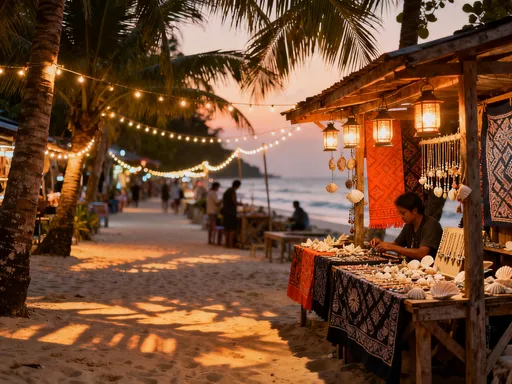
As the sun dips below the Andaman horizon, Walking Street comes alive in a way that feels both magical and effortless. By day, it’s a quiet path of sand and wooden planks connecting the island’s main beaches. But as dusk falls, strings of fairy lights flicker on, and dozens of vendors unfold their stalls along the route, transforming it into an open-air bazaar. There’s no formal structure—no stalls made of steel or plastic—but a charming collection of bamboo frames, fabric canopies, and hand-painted signs that sway gently in the sea breeze.
This is where the island’s shopping soul truly shines. I wandered slowly, letting my fingers brush over fabrics, test the weight of handmade soaps, and examine the delicate craftsmanship of beaded bracelets. One stall caught my eye with its display of coconut-shell earrings, each pair polished to a soft sheen and painted with tiny floral patterns. The woman behind the counter introduced herself as Noi, from the nearby Adang archipelago. She explained that her family has been making these for generations, using only fallen coconuts—never cutting down trees. For 300 baht (about $8), I bought a pair shaped like tropical leaves. More than the price, I valued the story behind them.
Another stall offered custom leather bracelets stamped with names, dates, or short messages. A young couple stood there, deciding what to engrave—“Honeymoon 2024” won out. The artisan, a quiet man named Jai, worked with a small hammer and metal stamp, pressing each letter by hand. There was something deeply personal about it: no machines, no mass production, just careful, deliberate creation. I asked if he ever gets tired of doing this every day. He smiled and said, “Every name has a story. I’m not just making bracelets—I’m helping people remember.”
Walking Street isn’t just a place to buy things—it’s a place to be seen, to connect, to slow down. Tourists sit on low wooden benches, sipping fresh fruit shakes while watching artisans at work. Children run between stalls, laughing as they chase fireflies. The atmosphere is warm, unhurried, and inclusive. Even those not buying anything are welcome to browse, ask questions, or simply enjoy the ambiance. It’s retail as community theater, where every interaction feels meaningful.
Hidden Gems Beyond the Main Strip
While Walking Street draws the crowds, some of the most memorable finds are just a few steps off the beaten path. I followed a narrow footpath behind Sunset Beach, guided by a local boy who offered to show me “the best batik shirts on the island.” Skeptical but curious, I followed him through a grove of coconut trees and emerged at a small bamboo hut shaded by banana leaves. Inside, an elderly couple sat cross-legged on mats, surrounded by stacks of hand-dyed fabric.
Their stall had no sign, no price tags—just a quiet dignity. The woman, wearing a faded sarong and thick reading glasses, unfurled a bolt of cloth to reveal a stunning geometric pattern in deep crimson and gold. She explained that each design is unique, created using the wax-resist method passed down from her mother. The dyes come from natural sources: turmeric for yellow, mangrove bark for brown, and clay pigments for red. I ran my hand over the fabric—it was thick, textured, alive with history. A shirt made from this material cost 800 baht, less than half what I’d pay at a boutique in Phuket.
These off-the-beaten-path vendors often operate with little overhead, allowing them to offer fair prices while still earning a decent living. Because they’re not located on the main drag, they rely on word of mouth and chance encounters. I met a fisherman who, during the off-season, carves wooden fish from salvaged driftwood. Each one is slightly different—some sleek and modern, others stylized with traditional motifs. He sells them for 200–400 baht, mostly to guests who stumble upon his little workshop near Sunrise Beach. “I don’t need much,” he said. “Just enough to fix my boat and feed my family.”
Exploring these hidden spots felt like uncovering secrets. There’s a thrill in discovering a place that hasn’t been tagged on Instagram a thousand times, where the experience feels private and genuine. One afternoon, I found a tiny kiosk selling hand-stitched tote bags made from recycled sailcloth. The owner, a woman named Lek, told me she started the business after her husband’s fishing boat was retired. “The sails were still strong,” she said. “So I turned them into something new.” I bought two—one for me, one for my sister. Not just because they’re durable and stylish, but because they carry a story of resilience and reinvention.
Why Local Craftsmanship Stands Out Here
What makes shopping on Koh Lipe so special isn’t just the beauty of the items—it’s the knowledge that each one is made by someone you can meet, speak to, and thank. This isn’t a supply chain of faceless factories and distant laborers. Here, the maker is often the seller. You can watch a woman hand-roll beeswax candles, see a man carve a seashell pendant, or observe a mother teaching her daughter how to weave pandanus leaves into a basket.
I spent an afternoon with a young artisan named Mali, who specializes in natural tie-dye using plant-based dyes. She invited me into her small workshop behind her family’s home, where cloth hung like flags in the breeze. She showed me how she extracts color from mangrove bark, soaking the wood in water for days until it releases a rich brown pigment. “My grandmother taught me this,” she said. “She said the forest gives us everything we need—if we know how to listen.” Her fabrics are sold in small batches, often pre-ordered by returning visitors who appreciate the slow, sustainable process.
This kind of craftsmanship isn’t just artistic—it’s cultural preservation. As global tourism pushes for faster, cheaper, and more uniform souvenirs, places like Koh Lipe stand as quiet resistance. These artisans aren’t trying to compete with factory-made goods. They’re keeping traditions alive, one handmade piece at a time. When you buy a batik scarf or a wooden spoon carved from coconut wood, you’re not just acquiring an object—you’re participating in a legacy.
Supporting local makers also has a direct impact on the island’s economy. Every baht spent goes straight to a family, not a corporate chain. I spoke with a community leader who explained that tourism income helps fund the local school, repair boats, and maintain freshwater systems. “When visitors buy from us,” he said, “they help keep our way of life going.” That shifts the act of shopping from consumption to contribution—a small but powerful form of travel with purpose.
Smart Shopping: How to Bargain (and When Not To)
Bargaining is a common practice in Thailand, and on Koh Lipe, it’s generally expected—especially on Walking Street. But after spending several days on the island, I learned that it’s not just about getting the lowest price. It’s about respect, relationship, and reading the situation. I quickly realized that not every vendor has the same margins. A young entrepreneur selling imported sunglasses might have room to negotiate. But an elderly woman selling hand-stitched quilts? Her profit is slim, and her time is precious.
My rule of thumb: start at around 70% of the asking price, especially if buying multiple items. Most vendors expect this and will counter with a slightly higher number. The key is to do it with a smile, not aggression. I’ve seen tourists haggle so hard it becomes uncomfortable—pleading, gesturing, refusing to walk away. That kind of pressure feels wrong here. Bargaining should feel like a friendly dance, not a battle.
I once tried to negotiate the price of a hand-carved wooden fish from an older man who clearly made them in his spare time. He quoted 350 baht. I offered 250. He paused, then said softly, “This took me three evenings to make.” I immediately felt ashamed. I paid the full price, bought a second one, and shared a coconut with him as we sat watching the waves. That moment taught me more than any bargain ever could.
Another tip: cash is still king on Koh Lipe. While some larger shops accept cards, most small vendors rely on cash. Bring small bills—100s and 50s—to make transactions smoother. And if you’re unsure about pricing, do a quick lap of the street to compare. You’ll notice that similar items hover around the same range. A well-made sarong, for example, typically costs between 400–600 baht. If one stall charges 200, it’s likely lower quality or mass-produced.
What to Buy (And What to Skip)
With so many options, it’s easy to overbuy or end up with souvenirs that lose their meaning back home. I learned to focus on items that are both beautiful and useful—things I’d actually use or display proudly. My top recommendations: reusable bamboo straw sets with carrying pouches, island-print tote bags made from organic cotton, and coconut oil soaps infused with lemongrass or tamarind. These are practical, eco-friendly, and deeply connected to the island’s resources.
Another standout find was a small stall selling coral-safe sunscreen made by a Thai eco-brand called SeaKeep. Unlike many tourist-area sunscreens that contain oxybenzone and harm marine life, this one uses mineral-based protection and comes in biodegradable packaging. I bought three—one for me, two as gifts. It wasn’t just a smart purchase; it sparked conversations when I got home about sustainable travel choices.
On the flip side, I avoided anything plastic, disposable, or generic. Cheap flip-flops, plastic keychains, and mass-produced “I ♥ Thailand” t-shirts are everywhere—but they’re also the first things to end up in landfills. They don’t reflect the island’s spirit, and they contribute to the environmental strain that small islands like Koh Lipe are already struggling with. Instead, I looked for items that felt personal and intentional.
One of my favorite purchases was a set of hand-painted seashell ornaments. A young girl, maybe ten years old, sat with her grandmother carefully painting tiny dots and swirls onto cleaned shells. They sold them for 50 baht each. I bought five. Not because I needed them, but because I wanted to support her family and carry home a piece of that quiet afternoon. Every time I look at them on my windowsill, I remember the sound of the waves and the smell of salt in the air.
How Koh Lipe’s Shopping Culture Is Going Viral
What was once a quiet island known mainly for diving and beach relaxation is now gaining attention for something unexpected: its authentic shopping culture. Thanks to social media, small vendors are being discovered by travelers worldwide. A TikTok video of a woman hand-stamping leather bracelets went viral, bringing thousands of views to a stall that once saw only a few dozen customers a week. Instagram reels showing the process of natural dyeing have inspired eco-conscious shoppers to seek out these artisans directly.
This digital exposure isn’t just boosting sales—it’s reshaping perceptions. People are beginning to see Koh Lipe not just as a place to unwind, but as a destination for meaningful connection and conscious consumption. Travelers are coming with lists: “Where can I find the coconut-shell earrings?” “Who makes the batik shirts near Sunset Beach?” This demand is encouraging more locals to share their crafts, creating a positive cycle of cultural exchange.
Some worry that popularity could lead to commercialization. But so far, the island has maintained its balance. There are no large souvenir malls, no chain stores, no pushy hawkers. The government and community leaders have been careful to preserve the island’s character, limiting development and encouraging sustainable practices. Even the most popular stalls remain small, family-run operations.
The viral attention has also inspired collaboration. I met a group of women who formed a cooperative to sell their handmade goods under a shared brand: “Lipe Hands.” They rotate shifts at a central stall, share materials, and support each other’s techniques. “Before, we worked alone,” said one member. “Now, we are stronger together.” Their story, shared online, has become a symbol of community-driven tourism.
Conclusion
Shopping on Koh Lipe is more than retail—it’s storytelling, culture-sharing, and slow travel in action. Every item has a maker, a method, and a memory. From the elderly couple dyeing fabric under a bamboo roof to the young girl painting seashells with steady hands, these moments of creation are what make the island unforgettable. As tourism evolves, Koh Lipe offers a powerful example of how commerce can be conscious, charming, and deeply human.
When you buy something here, you’re not just taking home a souvenir. You’re carrying a piece of a tradition, a gesture of kindness, a fragment of island life. The prices are modest, but the value is immeasurable. Next time you’re in the Andamans, come for the beaches—but stay for the stories waiting in the stalls. Let your purchases be more than objects. Let them be memories, connections, and quiet acts of support for a community that welcomes the world with open hands.